
Temporary Anchorage Devices
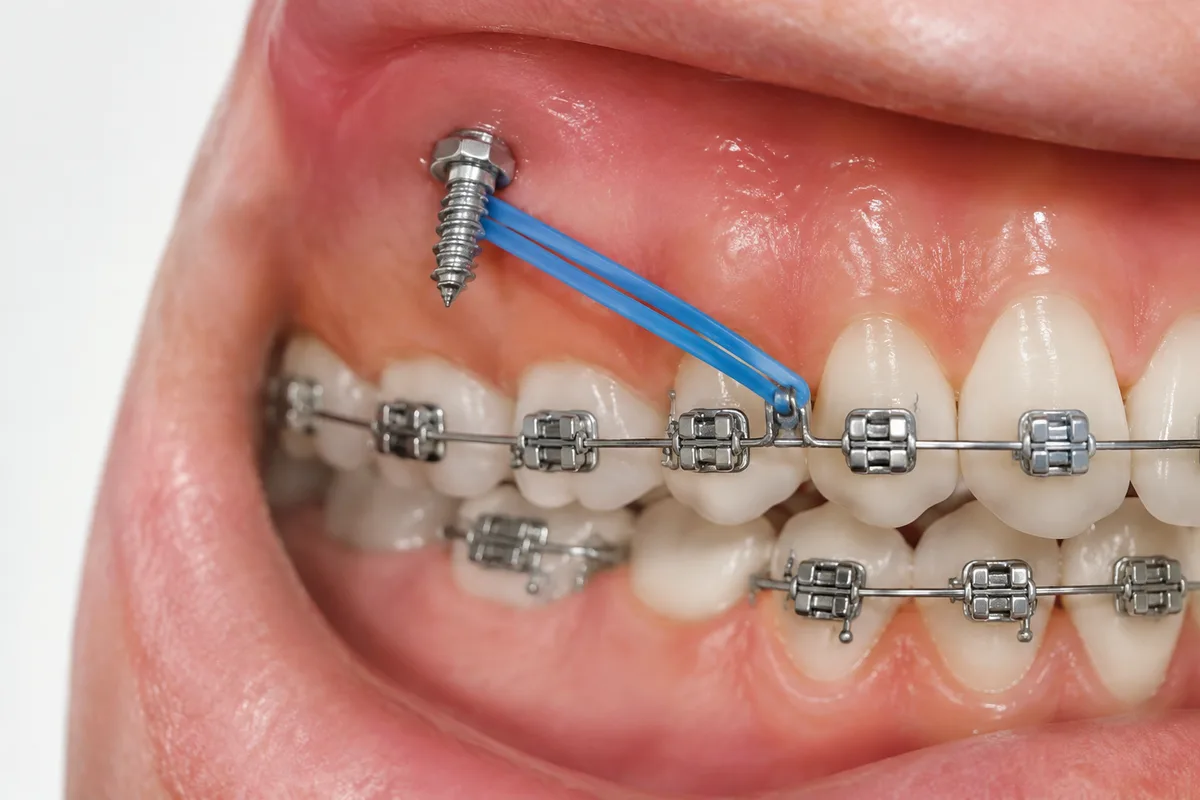
Temporary Anchorage Devices
Temporary Anchorage Devices, often called TADs, are small titanium anchors that give an orthodontist a fixed point to pull or push against while moving teeth. They are placed for the duration of a specific stage of treatment and removed once that movement is complete. At 1st Family Dental, TADs are one of the tools our orthodontic team can use to manage tooth movement with precision.
What Temporary Anchorage Devices are
A TAD is a miniature screw, usually just a few millimeters long, that is anchored into the jawbone. Once in place, it acts as a stable point that does not move the way a tooth does, so orthodontic elastics, springs, or wires can be attached to it to guide specific teeth in a controlled direction.
Before TADs were widely available, orthodontists relied mainly on other teeth, headgear, or removable appliances to create the resistance needed for certain tooth movements. Those approaches depend on patient cooperation and can shift the anchor teeth themselves, which sometimes limits how precisely a case can be planned. TADs give the orthodontist an anchor point that stays put, independent of patient compliance, which allows more predictable and targeted movement of the teeth that actually need to move.
How we use it at 1st Family Dental
Our orthodontic team includes Dr. Sameer Al-Obaidi, who is trained in the use of temporary anchorage devices alongside conventional braces, clear aligner systems, and other orthodontic appliances. When a treatment plan calls for a fixed anchor point, TADs can be incorporated into that plan as one option among several.
Because orthodontic planning at our practice can draw on 3D imaging and digital panoramic X-rays, the position of a TAD relative to roots, nerve pathways, and bone can be reviewed carefully before placement. TADs are typically used as part of a broader orthodontic course of care, working alongside braces, lingual braces, or clear aligners rather than as a standalone treatment.
What it means for you
For patients, the main appeal of TADs is control. Because the anchor point does not shift, the orthodontist can direct force more precisely to the teeth that need to move, which can reduce reliance on other teeth as anchors and may shorten the number of appliance adjustments needed to accomplish a particular movement.
- Precision — force is applied to a fixed point instead of relying on other teeth to hold position.
- Fewer compliance demands — unlike headgear or removable anchorage appliances, a TAD stays in place without patient effort.
- Clear communication — imaging taken before placement helps you and your orthodontist see exactly where the device will sit and why.
- Minimal disruption — the small size of a TAD means it generally does not interfere with speaking or eating once you adjust to it.
What to expect during your visit
Placement of a TAD is typically a short, in-office procedure. Before placement, the area is numbed with a local anesthetic, and imaging may be reviewed to confirm the exact spot chosen for the anchor. The device itself is then inserted directly into the bone through the gum tissue, a step that most patients describe as brief and no more uncomfortable than a routine dental injection.
After placement, mild soreness in the area is common for a day or two, similar to what you might feel after other minor dental procedures. Your orthodontist will attach the elastics, springs, or wires that connect the TAD to the teeth being moved, and you will return periodically for adjustments as treatment progresses. When the TAD has done its job, it is removed in a similarly quick, straightforward visit.
Frequently asked questions
Is placing a Temporary Anchorage Device painful?
The area is numbed with local anesthetic before placement, so most patients feel pressure rather than pain during the procedure itself. Some mild soreness afterward is normal and generally resolves within a few days.
How long does a TAD stay in place?
A TAD remains in place only as long as it is needed for the specific movement it supports, which varies from patient to patient depending on the orthodontic plan. Once that stage of treatment is complete, it is removed in a short visit.
Who is a candidate for TADs?
TADs may be considered for orthodontic patients whose treatment plan requires a fixed anchor point that other teeth cannot reliably provide. Your orthodontist will determine whether a TAD is appropriate for your case based on an examination and review of your imaging.
Will a TAD interfere with my daily routine?
Most patients adjust quickly and are able to eat, speak, and brush normally with a TAD in place. Your orthodontic team will give you specific care instructions for keeping the area around the device clean.
If you would like to learn whether Temporary Anchorage Devices are a fit for your orthodontic treatment, reach out to 1st Family Dental to schedule a visit and discuss your options.