
iTero Element Scanner
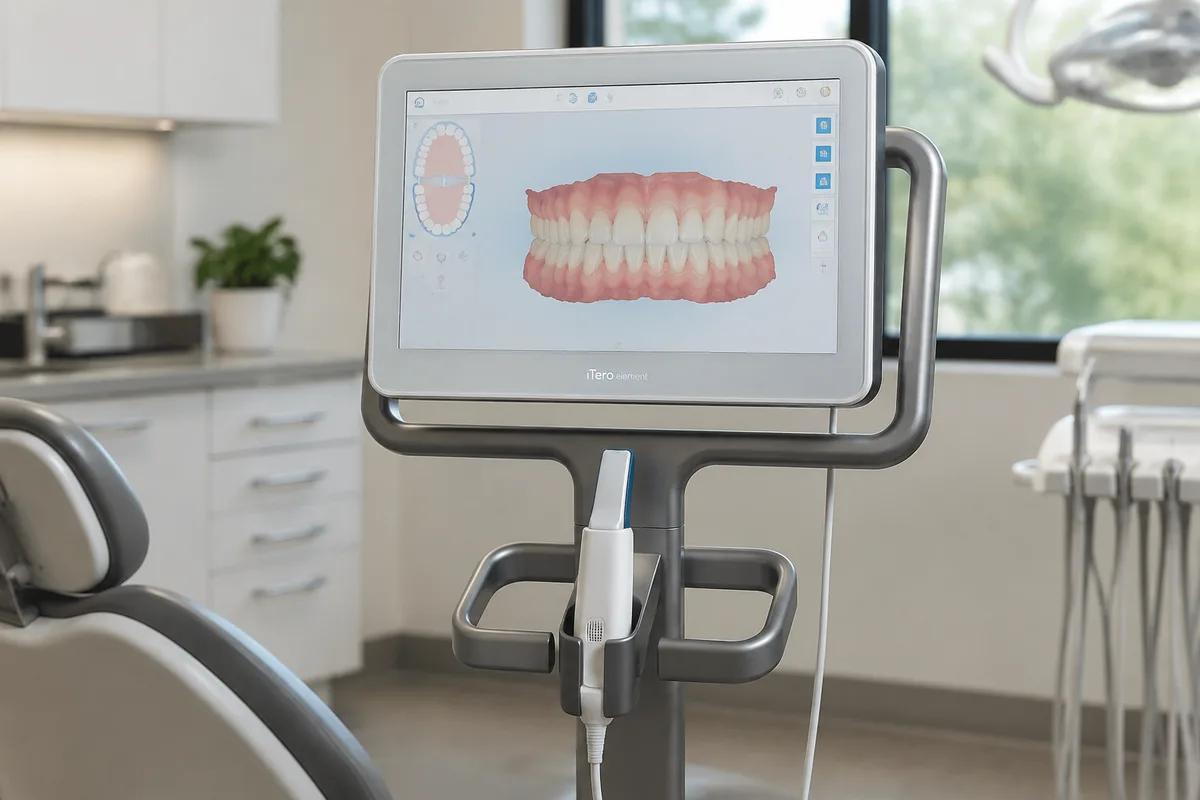
iTero Element Scanner
The iTero Element Scanner takes digital 3D impressions of your teeth and gums, replacing the trays of thick, messy putty that dentistry once relied on. At 1st Family Dental in Chicago, IL, this scanner supports treatment planning for Invisalign® clear aligners, retainers, and other restorations that depend on an accurate model of your smile.
What iTero Element Scanner is
An intraoral scanner is a small wand that captures thousands of images of your teeth and gum line as it passes over them, stitching those images together into a detailed 3D digital model. This model stands in for the physical impression that used to be made by biting into a tray of alginate or vinyl polysiloxane material and holding still while it set.
Because the scanning process is optical rather than physical, there is no material to mix, no tray to seat, and no risk of a gag reflex from putty sitting at the back of the mouth. The resulting digital file can be reviewed on a screen right away, magnified, rotated, and sent electronically to a lab or aligner manufacturer, which shortens the steps between your appointment and the fabrication of your aligners, retainer, or restoration.
How we use it at 1st Family Dental
At 1st Family Dental, the iTero Element Scanner is used to create digital 3D impressions of your teeth and gums for cases where a precise, current model of your bite is needed — most commonly for Invisalign® clear aligners and retainers. The scan captures how your teeth fit together and gives the treatment team a working model to plan the sequence of aligner trays or design a retainer that fits your mouth as it is today.
One feature patients often find useful is the ability to preview a simulation of your smile after treatment is complete, based on the digital model captured during the scan. This gives you a sense of the planned outcome before treatment begins, using the same data set that goes on to guide the aligner fabrication process.
The scanner works alongside other imaging tools available on-site, including digital X-rays and intraoral cameras, which give the clinical team additional views of tooth structure and soft tissue when planning comprehensive treatment.
What it means for you
Replacing a physical impression with a digital scan generally makes the experience more comfortable, since there is no tray held in place while material sets and no lingering taste or texture in the mouth afterward. Many patients who have gagged on impression material in the past find the wand-based scanning process easier to sit through.
A digital model can also be reviewed immediately on screen, so any area that needs a repeat pass can be rescanned on the spot rather than requiring an entirely new physical impression. Digital files transmit electronically, which can reduce back-and-forth mailing time between your dental office and an aligner or appliance lab.
What to expect during your visit
Before scanning, the clinical team will dry your teeth and may place a retractor or simply ask you to keep your lips and cheeks out of the way so the wand has a clear view. No numbing or sedation is needed for a scan.
During the scan, the wand is moved slowly over the outer, inner, and biting surfaces of your teeth and gums. You will be asked to stay still and keep your mouth open, but you can breathe and swallow normally throughout, and the team can pause at any point. A full-mouth scan typically takes a matter of minutes.
Afterward, the digital model appears on screen so you and the team can look it over together. Depending on your treatment plan, this model may be used right away to preview your projected smile or sent electronically to begin the next step, such as aligner or retainer fabrication.
Frequently asked questions
Is the iTero scan safe?
Yes. The scanner uses light and optical imaging to capture your teeth and gums, with no radiation involved. It is a non-invasive process that simply records the surfaces the wand passes over.
Does the scan hurt or feel uncomfortable?
Most patients find it more comfortable than a traditional putty impression, since there is no tray to hold in place and no material to set in the mouth. You may feel the wand moving along your teeth and gums, but there should be no pain.
How long does a scan take?
A full scan of the upper and lower teeth generally takes just a few minutes. The exact time can vary depending on how many areas need to be captured and whether any sections need to be rescanned for clarity.
Who is a digital scan suitable for?
Digital scanning is commonly used for patients being evaluated for or fitted with Invisalign® clear aligners or retainers, and it can be a comfortable alternative to a physical impression for many other patients as well. Your dentist can let you know whether a scan or another impression method fits your specific treatment plan.
If you would like to learn more about digital 3D impressions with the iTero Element Scanner, get in touch with 1st Family Dental to ask about scheduling a visit.