
Guided Implant Surgery
Guided Implant Surgery
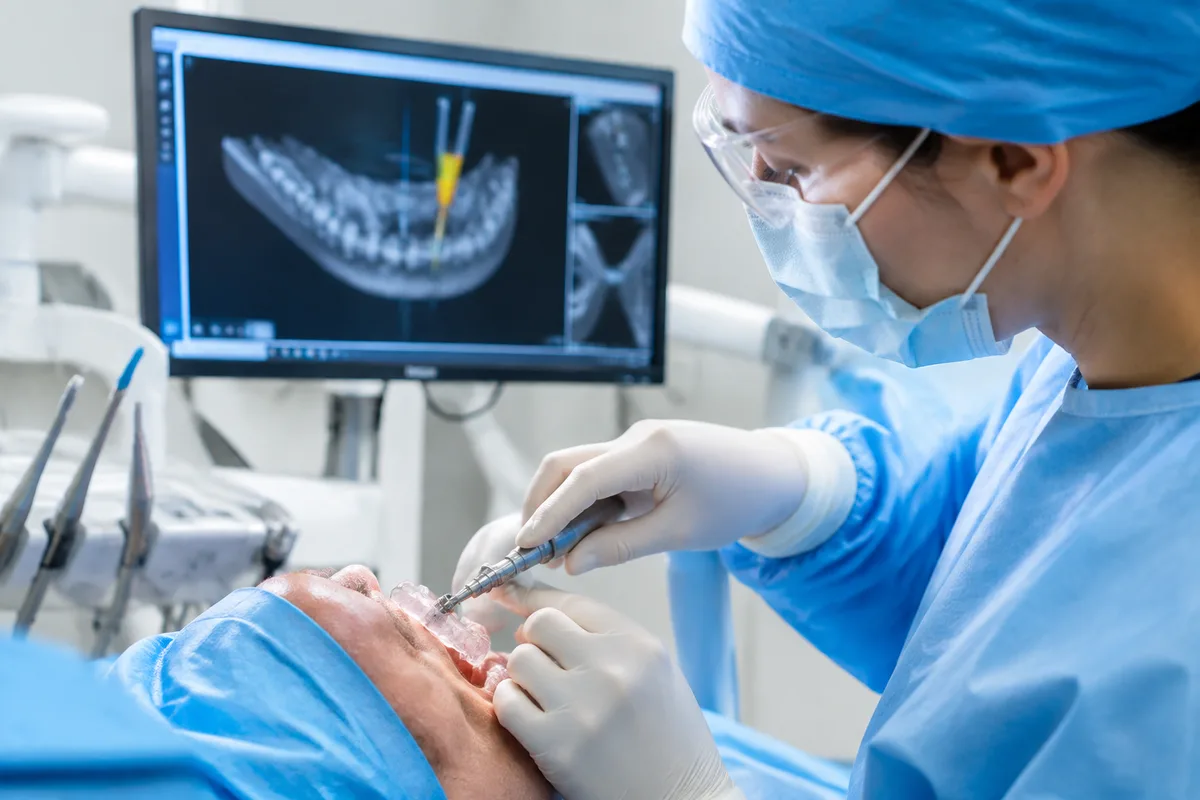
Guided implant surgery uses a 3D scan of your jaw to plan the exact position of a dental implant before any drilling begins. At 1st Family Dental in Chicago, this technology helps our implant team translate a digital plan into a precise, physical guide used chairside during surgery.
What guided Implant Surgery is
Traditional implant placement relies on a 2D X-ray and the surgeon's clinical judgment to estimate where an implant should go. Guided implant surgery adds a step: a 3D CT scan captures the full shape of the jawbone, the position of nerves, and the density of the bone in one image. That information is used to design a treatment plan and, in many cases, a surgical guide — a custom template that fits over the teeth or gums and directs the drill to the planned depth and angle for each implant.
This approach shifts much of the planning work to before the surgery even begins. Instead of making decisions in real time, the surgeon can review the anatomy, avoid nerves and sinus cavities, and confirm implant size and placement on a screen first.
How we use it at 1st Family Dental
Our office uses 3D CT Imaging to capture the detailed scan that guided implant cases require, showing teeth, soft tissue, nerve paths, and bone density together. We also use Digital Panoramic X-Rays for broader mouth and jaw views during planning. That imaging feeds into the surgical guide that positions each implant at the angle and depth mapped out in advance.
On our team, Dr. Najeeb Abufarha has completed training specifically in guided surgery, digital treatment planning, and 3D imaging as part of his focus on dental implants and full-arch implant restorations. Dr. John Hur, our oral surgeon, has training centered on CT-guided skeletal mapping and surgical protocols for complex implant cases. Dr. Irbad Chowdhury, an implantologist with a dental implant fellowship, also focuses his practice specifically on dental implants. Depending on your case, guided planning may also connect with related services we offer on site, such as Piezo Bone Surgery for gentler bone shaping, Implant in a Day for same-day temporary crowns, and All-on-4 implant dentistry for full-arch cases.
What it means for you
Because the plan is built from a detailed scan rather than estimated during surgery, guided implant surgery is generally associated with a more predictable, minimally invasive approach to placement. Many patients find the process easier to understand, since the plan can be shown and explained using the same images used to design the surgical guide.
Other general benefits patients often experience with guided approaches include:
- Precision — the guide keeps the drill at the planned angle and depth throughout surgery.
- Reduced guesswork — nerves, sinuses, and bone density are mapped before surgery starts.
- Clearer communication — the 3D images make it easier to see and discuss the plan together.
- Efficient surgery time — much of the decision-making happens during planning, not in the chair.
What to expect during your visit
A guided implant case typically starts with a consultation and a 3D CT scan, which is quick and non-invasive. From that scan, your treatment plan is developed and, where appropriate, a surgical guide is fabricated to match your anatomy. This planning stage may take place over one or more visits before surgery is scheduled.
On the day of surgery, the guide is placed over the treatment area, and the implant is positioned according to the plan. Local anesthesia is used to keep the area numb during placement, and the length of the appointment depends on how many implants are being placed. Afterward, you'll receive instructions for healing, and follow-up visits are scheduled to monitor the implant site as it integrates with the bone.
Frequently asked questions
Is guided implant surgery safe?
Guided implant surgery is a widely used approach in modern implant dentistry. Because the plan is based on a detailed scan of your bone, nerves, and sinus structures, it is designed to reduce uncertainty during placement. Your dentist will review your health history and imaging with you before recommending this approach.
How long does the process take?
The planning phase, including the CT scan and guide fabrication, generally takes place before the surgical appointment itself. The surgery visit varies in length depending on how many implants are being placed and whether any additional procedures, such as bone grafting, are needed.
Will I need a separate scan appointment?
In most cases, the 3D CT scan used for planning is captured at our office as part of your implant workup. This scan is used both to design your treatment plan and, when needed, to fabricate the surgical guide used during your procedure.
Who is a candidate for guided implant surgery?
Guided implant surgery can be considered for patients who are candidates for dental implants, including single-tooth replacement and full-arch cases such as All-on-4. Whether it's the right approach for you depends on your bone structure, health history, and treatment goals, which your dentist will discuss with you during a consultation.
If you're considering dental implants and want to know whether guided implant surgery is right for you, get in touch with 1st Family Dental to schedule a consultation.