
Digital Panoramic X-Rays
Digital Panoramic X-Rays
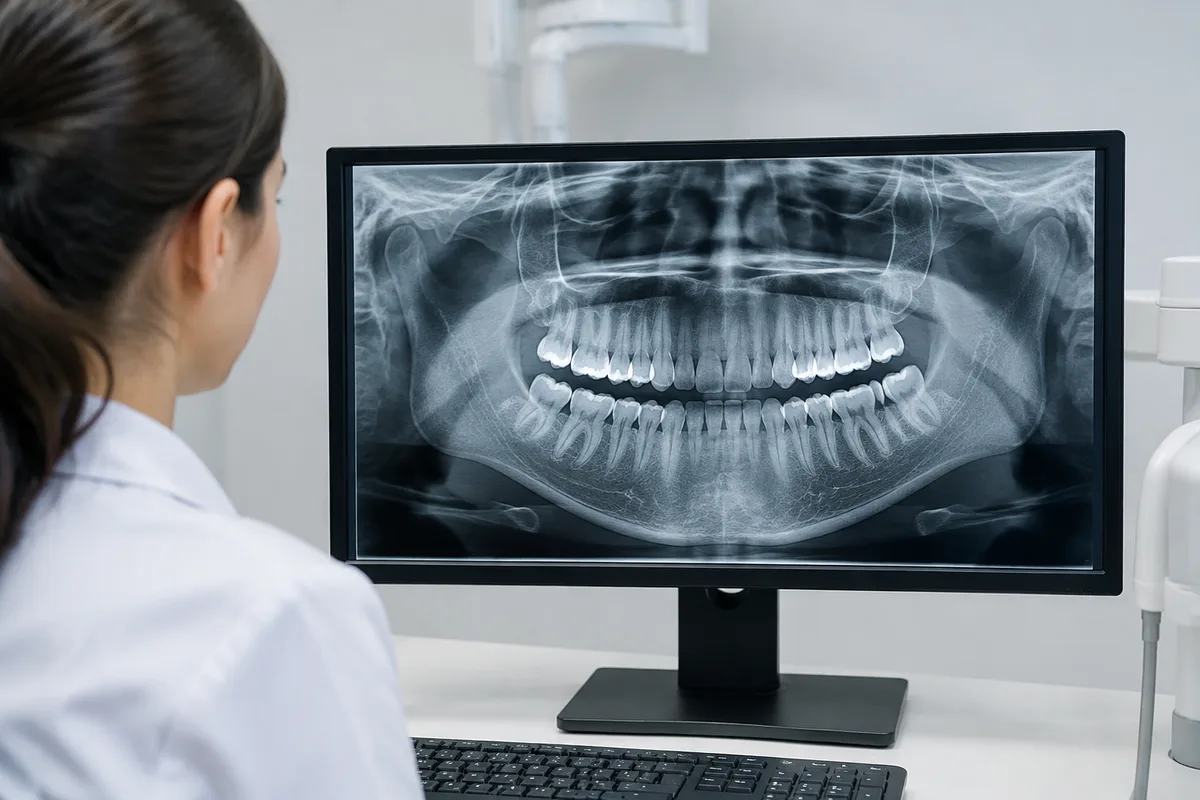
A digital panoramic X-ray captures the entire mouth in a single image — every tooth, both jaws, the sinuses, and the joints that connect your jaw to your skull. At 1st Family Dental in Chicago, IL, this wide-view scan helps our dentists, orthodontists, and oral surgeons see the full picture before recommending any treatment, from a simple filling to a complex implant plan.
What digital Panoramic X-Rays is
A panoramic X-ray uses a machine that rotates around your head, capturing a continuous, flattened image of your upper and lower jaw, teeth, sinuses, nasal area, and temporomandibular (jaw) joints. Unlike a traditional bitewing or periapical X-ray, which focuses on a few teeth at a time, a panoramic image shows everything in one sweep.
Digital versions of this technology replaced older film-based panoramic units. Instead of processing chemical film, the image appears on a computer screen within seconds, using a sensor rather than film. This means the scan can be reviewed, enlarged, and stored digitally, and it typically requires less radiation than older film methods.
How we use it at 1st Family Dental
Because a panoramic X-ray shows the whole mouth and jaw at once, our team relies on it for planning that requires a broad view rather than a close-up of one or two teeth. This includes evaluating wisdom teeth before extraction, checking the position and eruption pattern of teeth for orthodontic treatment such as braces or Invisalign, and getting an initial look at bone structure before implant placement or All-on-4 implant treatment.
The panoramic scan often works alongside our other imaging tools rather than replacing them. When a case calls for more depth — for example, precise bone density and nerve mapping ahead of guided implant surgery — the panoramic image can be paired with our on-site 3D CT imaging for a more detailed view. For orthodontic cases, the panoramic X-ray is frequently reviewed together with digital impressions from our iTero Element Scanner to plan tooth movement.
Every X-ray taken in our offices, panoramic included, is captured digitally rather than on film, and we provide a protective apron and collar for every patient during the scan.
What it means for you
A single panoramic image reduces the need to take several smaller X-rays to see different areas of the mouth, which can mean fewer individual exposures during a visit. Because the image is digital, it can be pulled up immediately on a screen, making it easier for your dentist to point out what they see and explain a recommendation in plain terms.
Digital imaging also uses less radiation than older film-based systems, and the image quality can be adjusted on-screen — brightened, zoomed, or cropped — without needing to retake the scan. For patients being evaluated for orthodontics, wisdom teeth, or implants, this broad view often means fewer separate imaging appointments before a treatment plan can be discussed.
What to expect during your visit
Before the scan, you will be asked to remove any metal objects, such as jewelry, glasses, or a removable retainer, since these can obscure the image. A lead apron and thyroid collar are placed for protection.
During the scan, you will stand or sit in the panoramic unit and bite gently on a plastic guide to hold your head steady. The machine's arm rotates around your head one time, and you will be asked to stay still and hold your breath briefly during the pass. The scan itself takes well under a minute.
Afterward, the image appears on a computer screen almost immediately. Your dentist or specialist will review it with you, pointing out anything relevant to your visit, whether that's the position of a wisdom tooth, the alignment of your bite, or the bone available for a future implant.
Frequently asked questions
Is a digital panoramic X-ray safe?
Yes. Digital panoramic X-rays use a low dose of radiation, generally less than older film-based panoramic machines, and a protective apron and collar are used during the scan. Your dentist will only recommend imaging when it is useful for diagnosis or treatment planning.
Does the scan hurt or feel uncomfortable?
No. The scan is painless. You may feel the plastic bite guide against your teeth and need to hold still while the machine rotates around your head, but there is no pressure, sound, or sensation beyond that.
How long does it take and how often is it needed?
The scan itself takes less than a minute, though the full visit including positioning and review of the image is quick. How often a panoramic X-ray is needed depends on your individual situation — it is commonly used before orthodontic treatment, wisdom tooth evaluation, or implant planning, rather than at every routine cleaning.
Who is a panoramic X-ray suitable for?
Panoramic X-rays are used for patients of a wide range of ages, including children being evaluated for orthodontic treatment and adults being considered for wisdom tooth removal or dental implants. Your dentist will determine whether this type of imaging fits your particular needs.
If you would like to learn more about digital panoramic X-rays or find out whether one is right for your next visit, reach out to 1st Family Dental — we're happy to answer your questions.