
All-on-4® Implant Dentistry
All-on-4® Implant Dentistry
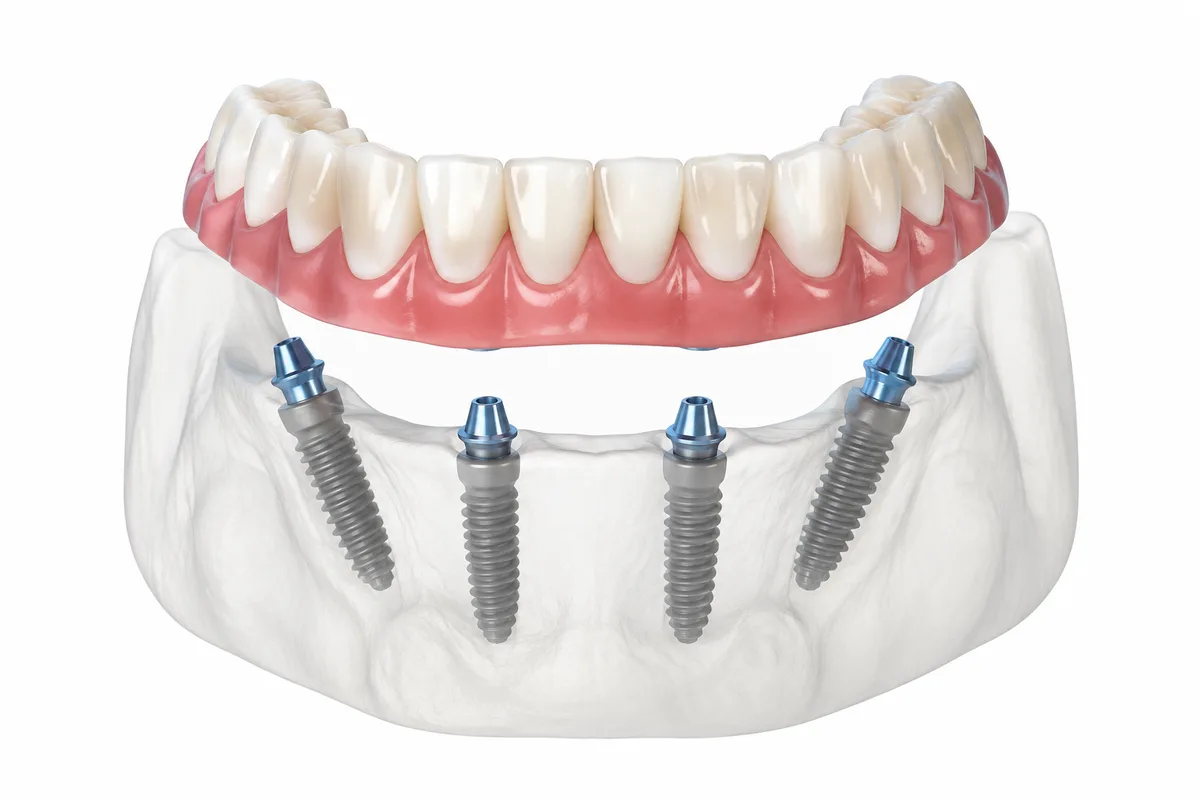
All-on-4® Implant Dentistry is a way to replace a full arch of missing or failing teeth with a fixed, implant-supported bridge anchored by just four implants. For patients who have lost most or all of their teeth on the top or bottom arch, or who are facing that possibility, it offers an alternative to a removable denture. At 1st Family Dental in Chicago, IL, this treatment is planned and provided by our prosthodontists and implant team.
What all-on-4® Implant Dentistry is
A traditional full denture rests on the gums and can shift, slip, or need adhesive to stay in place. Traditional implant-supported dentures have often required six or more implants per arch, which isn't always possible for patients who have lost bone over time. All-on-4 was developed to work around that limitation: two implants are placed toward the front of the jaw and two are angled toward the back, using the denser bone that is typically still available in those areas even after long-term tooth loss.
Those four implants act as anchors for a full-arch bridge, which is either fixed permanently or designed to be removed only by a dentist for cleaning. Because the implants integrate with the jawbone, the replacement teeth function much more like natural teeth than a conventional denture, and because fewer implants are needed, the approach can sometimes reduce the need for extensive bone grafting before treatment.
How we use it at 1st Family Dental
Planning starts with a clear picture of the jaw. Our practice uses 3D CT Imaging and Digital Panoramic X-Rays to evaluate bone density, nerve position, and the overall shape of the arch, which allows the implant positions to be mapped out before any surgery takes place. From there, Guided Implant Surgery uses that same imaging to help place each of the four implants at the planned angle and depth, and Piezo Bone Surgery instruments can be used to shape bone gently where needed during the procedure.
Treatment planning and surgical care for All-on-4 cases are handled by our prosthodontists, including Dr. Ghassan Abboud, Dr. Faisel Ashtewi, and Dr. Tala Ghishan, alongside team members with dedicated implant training such as Dr. Najeeb Abufarha and Dr. Irbad Chowdhury. When bone grafting is needed to support the implants, that is coordinated as part of the same treatment plan. In appropriate cases, our Implant in a Day approach allows a temporary crown or bridge to be attached the same day the implants are placed, so patients aren't without teeth while healing begins.
What it means for you
For patients who have struggled with a loose or uncomfortable denture, a fixed All-on-4 bridge can mean not worrying about slipping while eating or speaking. Because the plan is built from a 3D scan rather than guesswork, the surgical team knows in advance where each implant needs to go, which supports a more predictable, efficient procedure. Using intraoral cameras during exams and consultations also means you can see the same images your dentist is looking at, so treatment options are discussed with a shared understanding rather than just a verbal description.
Because fewer implants are typically needed compared with older full-arch approaches, some patients who were told they lacked sufficient bone for traditional implant dentures may still be candidates for All-on-4. That said, every jaw is different, and whether grafting or other preparation is needed is determined case by case.
What to expect during your visit
Your first visit will include a conversation about your dental history, a clinical exam, and imaging with digital X-rays and a 3D CT scan so the team can see the bone and nerve structure of your jaw. From there, your prosthodontist reviews the scan with you, explains where implants would be placed, and discusses whether a fixed or removable-by-dentist bridge design fits your situation.
On surgery day, local anesthesia is used, and nitrous oxide sedation is available for patients who feel anxious about the procedure. The four implants are placed according to the guided plan, and if you're a candidate for Implant in a Day, a temporary bridge is attached before you leave. The implants then need a healing period to integrate with the bone before your final, custom bridge is fitted.
Frequently asked questions
Is All-on-4 implant surgery safe?
All-on-4 is a well-established surgical technique that uses careful imaging and planning to guide implant placement. As with any surgical procedure, your dentist will review your health history and the scan of your jaw before recommending it, and will explain what to expect at each step.
How long does the process take?
The overall timeline varies by patient because it depends on healing and bone quality, but the process generally involves an initial planning phase, a surgical visit to place the implants, a healing period, and a final visit to fit the permanent bridge. Your prosthodontist can outline a timeline specific to your case after your CT scan.
Will I be without teeth while I heal?
Not necessarily. For patients who qualify for our Implant in a Day option, a temporary bridge can be attached to the implants on the same day they're placed, so there isn't a gap in your smile during the healing period.
Who is a good candidate for All-on-4?
All-on-4 is generally considered for patients who have lost most or all of their teeth in an arch, or whose remaining teeth are failing, and who want a fixed alternative to a removable denture. Candidacy depends on your bone structure and overall oral health, which is why a 3D scan and exam come before any recommendation.
If you'd like to know whether All-on-4® Implant Dentistry is right for you, reach out to 1st Family Dental to schedule a consultation.